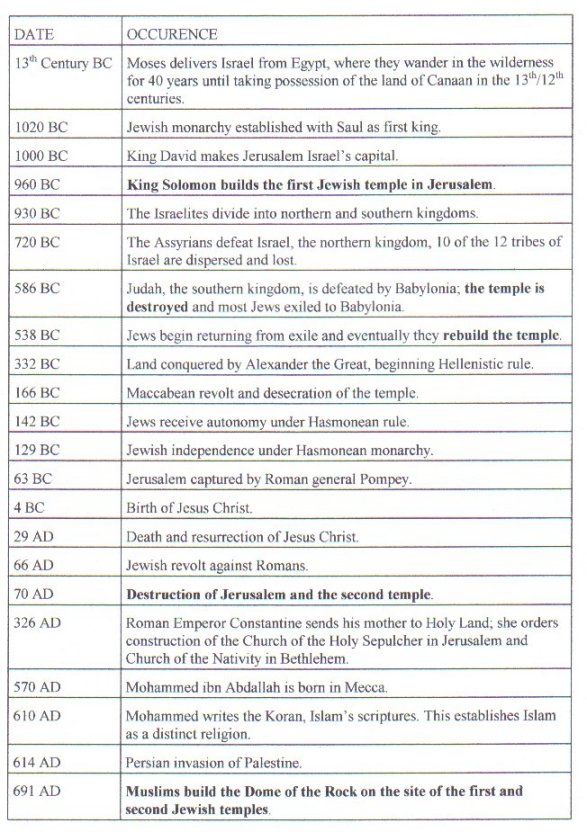
There are those who wish to establish the date of Revelation during the reign of Nero (64 AD) in an attempt to prove that the book was written before the fall of Jerusalem. They do this to disprove that the prophecies of Revelation are in the future. One way they endeavor to accomplish this is by using the command to John to measure the Temple as proof it was still in existence when he received his vision. About this, Bible scholar Tim LeHaye in Revelation Unveiled says the following: “One problem with their reasoning is that we have Biblical precedent for God’s commanding His servant Ezekiel (Ezek. 40-44) to measure the Temple long after it had been destroyed by the armies of Nebuchadnezzar six hundred years before Christ. Daniel also prophesied a desecration of the temple when it was still nonexistent. Obviously, if the temple referred to by these Old Testament prophets was of a future temple, then it follows that John in vision (in A.D.95) saw a future Temple, one that is yet to be desecrated by the Antichrist (a Temple yet to be rebuilt during the Tribulation period). The fact that many Jewish groups are preparing materials today for just such an occasion to rebuild the Temple leads many to think we are coming close to the time of these prophesied events.”
Although this venue isn’t conducive to an analytical discussion of the history surrounding the date Revelation was written by the Apostle John, most scholars date the book between 95 and 100 AD. Furthermore, the book itself declares itself as a testament of “what will take place later” (Revelation 1:19). This book is easily divided into what John has seen (chapter 1), what is now (chapters 2 & 3) and what will take place later (remaining chapters). Based on the evidence that this book was written between 95 and 100 AD and since the temple (Herod’s Temple) that existed during Christ’s sojourn as the God-man upon the earth was utterly destroyed in 70 AD in accordance with His Word (Matthew 24:1 & 2), it therefore becomes clear that the temple John is to measure is in the future.
Revelation 11:1, 2
I was given a reed like a measuring rod and was told, "Go and measure the temple of God and the altar, and count the worshipers there. But exclude the outer court; do not measure it, because it has been given to the Gentiles. They will trample on the holy city for 42 months.
As stated, the Temple that John is to measure is in the future. It is wise at this juncture to re-study Daniel 9:24-27 as it relates to Israel’s prophetic future. Remember that this prophetic passage told (1) of the rebuilding of the Temple (538 BC), (2) the coming of and atoning death of Christ, (3) the destruction of the Temple (70 AD) and (4) the coming of the Antichrist who will make a covenant with many (nations for the purpose of securing Israel’s peace and the rebuilding of the Temple - still in the future) for a period of seven years (Tribulation Period) only to (5) break it in three and a half years and to at that time end Temple sacrifices and offerings and to desecrate (“set up an abomination that causes desolation”) the Temple.
Tim LaHaye’s comments from his book Revelation Unveiled regarding this passage are enlightening. They follow for the reader’s consideration.
Several passages of Scripture refer to the Temple of the end time. In Matthew 24:15 the Lord Jesus referred to the “abomination that causes desolation, spoken of through the prophet Daniel,” indicating that at the end time, in the middle of the Tribulation period as Daniel predicted, a temple will be desecrated by the Antichrist. In order for this to be fulfilled it must first be rebuilt. Likewise, in 2 Thessalonians 2:1-13 the Apostle Paul predicted that the Antichrist, in the middle of the Tribulation, would defy God by sitting in the Temple of God and presenting himself to the world as God. In order for him to do this that temple has to be rebuilt.
Ever since the Nation Israel was reestablished on May 14, 1948, the Jewish people have dreamed about and planned for the rebuilding of their Temple. This vision was intensified when in 1967 as a result of the “Six-day War” Israel was left with the control of the Gaza Strip, the Sinai Peninsula, the West Bank, the Golan Heights and East Jerusalem. General Moshe Dayan declared on June 7, 1967, “We have returned to our holy places, never to part from them again.”
Today this compulsion to rebuild the Temple is stronger than ever, yet to many there is one major remaining impediment to their plan. The location of their new Temple must be constructed on the site of their two previous temples. This is over Mount Moriah, the place considered to be the site of Abraham’s offering of his son Isaac as a sacrifice of obedience to and faith in God. But since the Muslims occupied Israel’s land (because it was given to Israel by God), they constructed in 691 AD the Dome of the Rock, a shrine commemorating the spot they believe Mohammed ascended into heaven in a “night journey.” This location and shrine is a major contention between Israel and the Palestinians today. This is a non-negotiating point between them, which apparently appears as an impasse to peace between Israel and Palestine. But is it?
Those readers who are fortunate enough to have access to Hal Lindsey’s pictorial book, A Prophetical Walk Through the Holy Land, or the March-April 1983 Biblical Archaeology Review, will find a most amazing and important archaeological discovery of modern times. As Hal Lindsey states, From the standpoint of biblical prophecy, it is one of the most crucial factors in a final alignment of predicted events that will precede the final seven years of history before the Messiah returns. This discovery made by Dr. Asher Kaufman, a professor of physics at Hebrew University, established that the previous temple foundations do not lie exactly under the Dome of the Rock but rather about 100 meters away from it. Although space and time will not be allotted here to detail Dr. Kaufman’s findings, the following points are mentioned in hopes that the reader will take time to research the matter further.
Dr. Kaufman shows that the Dome of the Rock could not be on the actual site of the ancient Jewish Temple due to:
1. Its position in relation to the important Eastern Gate. Photographs of the Eastern Gate and the golden-domed mosque clearly show that the mosque is about 100 meters south of a line drawn directly west from the Eastern Gate. Ancient writings, including the Mishnah, indicate that the Eastern Gate led directly to the Temple. The model of Jerusalem in Jesus’ day revealed that the Eastern Gate was centered precisely on the east-west alignment of the Temple. A line drawn from the center of the Eastern Gate, perpendicular to the city wall into which it was built, will pass right through the center of the “Dome of the Tablets and the Spirits.” As Lindsey says, This could not have been a mere coincidence; the Eastern Gate must have been purposely aligned with the place where the Ark of the Covenant rested within the holiest part of the Temple.
2. The “Dome of the Tablets and the Spirits,” the little cupola that has gone unnoticed for centuries at the northwest corner of the Temple platform, is believed to be centered on the bedrock foundations of the two previous temples and is one of the holiest places on earth. Dr. Kaufman advances this position, since this dome (cupola) is situated over a smooth, flat rock mass that is actually part of the bedrock of Mount Moriah. It is only one meter lower than the only other exposed bedrock of the Temple area - the Temple Mount’s highest point, over which the Dome of the Rock stands. The bedrock under the cupola is unique in that it is flat and yet bears no evidence of having been shaped by tools. This indicates that this site was recognized as a holy place since no paving stones were ever placed over it. Also, the Moslems who originally built the Dome of the Rock complex in the eighth century gave this cupola two important and revealing names, i.e., Qubbat el-Arwah, which means “the Dome of the Spirits” (so named to preserve the memory of God’s presence over the Mercy Seat, above the Ark of the Covenant, which sat on the flat bedrock unshaped by human hands) and Qubbat el-Alouah, which means “the Dome of the Tablets” (to reverence the memory of the tablets of the Law given to Moses by the Lord on Mount Sinai and later placed inside the Ark of the Covenant). This area upon which the cupola stands is therefore the place where the manifest presence of God dwelt for centuries. This was a place so holy that only the high priest could enter it once a year with the blood of a divinely prescribed sacrifice (Leviticus 16).
3. The traditional belief that the large rock under the Dome of the Rock was part of the ancient Temple foundation, which has been traced back to a Moslem Jew of the eighth century, named Wahb ibn Monabbih, has been shown to be illogical by Dr. Kaufman. This is so because neither one of the two main theories concerning the placement of the Temple can be reconciled with the exact descriptions recorded in the Mishnah (a collection of laws, regulations and customs governing religious practice during the period of the Second Temple).
4. Dr. Kaufman, upon discovering evidence on the Temple Mount in the Mishnah, the Tosefta and the writings of a Jewish historian named Josephus, who lived at the time of the Second Temple’s destruction, came to the conclusion that the coming “Tribulation Temple” can now be built without disturbing the Dome of the Rock. The Temple and its immediate guard wall can be re-built and still be 26 meters away from the Dome of the Rock.
The impact of this discovery by Dr. Kaufman is profound. It lends unusual clarity to the first two verses of Revelation 11. It means that a “temporary peace” instigated by the Antichrist can take place between Israel and the Palestinians without the destruction of the Dome of the Rock. This is best expressed by Hal Lindsey in his book, A Prophetical Walk Through the Holy Land, which is as follows:
Revelation chapter 11 indicates this very situation: “I was given a reed like a measuring rod and was told, ‘Go and measure the temple of God and the altar, and count the worshipers there. But exclude THE OUTER COURT; do not measure it, because it has been given to the GENTILES. They will trample on the holy city for 42 months’” (Revelation 11:1, 2 NIV). The outer court, which includes the area where the Dome of the Rock is situated, was given to the Gentiles. So this prophecy accurately reflects the situation that is present today. The stage is fully set for the False Prophet of Israel and the Antichrist of Rome to be revealed to the world and initiate the construction of the Third Temple. It is mind-boggling to realize that this piece of bedrock, which was the site of the Ark of the Covenant and God’s presence, will very soon be the place where the Antichrist will take his seat and proclaim himself God (2 Thessalonians 2, 3, 4). That act, according to the Lord Jesus (Matthew 24:15-22), will trigger the three-and-one-half-year-long Great Tribulation and the worst war of all time. All of these things are tremendously exciting to those who know Bible prophecy. We are literally in the very last days of the Church Age. The Temple will be rebuilt soon!
A temporary peace will be achieved for Israel when the Antichrist comes on the scene (an “anytime now” or “just-around-the-corner “ event) and establishes his covenant “with many” nations (the European Union, certain Arabian states and Israel) for a period of seven years, thereby initiating the Tribulation Period. During the first half (three and a half years) of the Tribulation or even before it, the Jewish people will rebuild their Temple and resume animal sacrifices - a further rejection of Christ Jesus. This will continue for 42 months (three and a half years), at which time the Antichrist will break his covenant that protects the Jews and will then enter the Temple and proclaim himself God, which is the “abomination of desolation.”
Revelation 11:3-6
And I will give power to My two witnesses, and they will prophesy for 1,260 days, clothed in sackcloth." These are the two olive trees and the two lampstands that stand before the Lord of the earth. If anyone tries to harm them, fire comes from their mouths and devours their enemies. This is how anyone who wants to harm them must die. These men have power to shut up the sky so that it will not rain during the time they are prophesying; and they have power to turn the waters into blood and to strike the earth with every kind of plague as often as they want.
At the beginning of the Tribulation, God will send down two witnesses to “prophesy” and give “testimony” (vs. 7) for 1,260 days, which equates to 42 months or three and a half years - the first half of the Tribulation Period. These two witnesses are referred to symbolically as “the two olive trees and the two lampstands that stand before the Lord of the earth,” but while on earth they are in human form and dressed in sackcloth. In other words prior to being assigned this detail, they occupied prominent positions before Jesus Christ. While completing this assignment, these two witnesses are allocated a tremendous amount of power. They are able to eject fire from their mouths to incinerate their enemies; in fact, anyone wishing (attempting) to harm these two must die in this fashion. They have the power to keep rain at bay while they are delivering their message, to turn water into blood and to inflict the earth with every kind of plague in an unlimited manner. So who are these two witnesses?
It is certain, according to the description, that these two witnesses are human. According to Deuteronomy 17:6, two is the required number of witnesses required by God’s Law. In fact, there is even mention of the relevancy of two witnesses by Christ in one of His parables (Matthew 18:16).
Everything in these verses is associated with the Old Testament. The two olive trees suggest the vision in Zechariah 4:14, which are said to be “the two who are anointed to serve the Lord of all the earth.” The lampstands convey that the two witnesses are lights before the powers of darkness.
God doesn’t tell us who they are and this should be sufficient for the reader. Yet it doesn’t hurt to guess, as long as it is understood that any identification of these two is purely speculation. Not knowing their identities does no harm to the understanding of the message of this passage. The following are the three primary views taken by almost all conservative, God-fearing Bible scholars regarding these two “witnesses.”
1. Elijah and Enoch. Almost everyone accepts that one of the witnesses is Elijah. They base this primarily on Malachi 4:5, 6, "See, I will send you the prophet Elijah before that great and dreadful day of the LORD comes. He will turn the hearts of the fathers to their children, and the hearts of the children to their fathers; or else I will come and strike the land with a curse." Furthermore, the use of fire by Elijah in the ministry of God was no strange event (1 Kings 18:20-40). Christ also mentioned the coming of Elias (Elijah) in Matthew 17:11. Then again, Elijah was one of the two who met with Christ on the Mount of Transfiguration (Matthew 17:1-3). John the Baptist specifically stated that he was not Elijah; although, he did come in the “spirit and power of Elijah.” (John 1:21; Luke 1:17).
So what about Enoch? If Elijah, a Jew, is a representative of Israel; then Enoch, a Gentile, could be a representative of all non-Jews. The primary reason many believe the second witness will be Enoch is because he did not die (Genesis 5:24; Hebrews 11:5) and since “man is destined to die once” (Hebrews 9:27), it is conjectured that he will die as one of the “two witnesses.” Now if the death spoken of in Hebrews 9:27 is assumed to be “physical death,” then one may have a point. If this were so, there would then be difficulty explaining why so many do not experience physical death, but testify, “Where, O death, is your victory? Where, O death, is your sting?” as their physical bodies are instantly and miraculously transformed while ascending up to Christ in the clouds during the Rapture (1 Corinthians 15:51-55; 1 Thessalonians 4:15-17). A careful reading of Hebrews 9 reveals that the writer is speaking of “spiritual death,” which befalls all mankind (Romans 5:12; 2 Corinthians 5:14), and for which it was necessary for Christ to come and bring salvation to all who are under the verdict of “spiritual death” by the shedding of His blood once and for all (Hebrews 9:14, 28; 10:10, 18). So the truth is that man must (1) die spiritually (see above scriptures), (2) he must be born twice (physically and spiritually - John 3:5), but (3) he need not die at all (see Enoch and Rapture scriptures above) in order to have eternal life.
The other reason Enoch is sometimes selected as the “other witness” is because of his prophecy regarding the Second Coming of Christ as depicted in Jude 14, Enoch, the seventh from Adam, prophesied about these men: “See, the Lord is coming with thousands upon thousands of his holy ones to judge everyone, and to convict all the ungodly of all the ungodly acts they have done in the ungodly way, and of all the harsh words ungodly sinners have spoken against him.” The fact that he prophesied regarding this event doesn’t make him the “other witness,” but he could very well be him.
2. Elijah and John the Baptist. The argument for Elijah is above, but what about John the Baptist. John the Baptist definitely stated that he was not Elijah, yet J. Vernon McGee in his Thru The Bible series makes this interesting argument, My suggestion is that John the Baptist is the second witness. He was the forerunner of Christ at His first coming. He was similar to Elijah in manner and message. I am sure that those two fellows would get along with each other. Both knew what it was to oppose the forces of darkness and to stand alone for God against impossible odds. They surely have had good training in the past. John the Baptist would be the witness of the New Testament, as Elijah would be the witness of the Old Testament. So here is another possibility.
Elijah and Moses. Again, the argument for Elijah is above. As for Moses, I can’t put it any better than Tim LeHaye in his book Revelation Unveiled, which follows.
There are, however, three good reasons why Moses is the second witness during the first part of the Tribulation Period.
1. In Matthew 17:1-5, when the Lord Jesus was transfigured before His Jewish witnesses-Peter, James, and John-two representatives of the Old Testament were brought before their view: Moses and Elijah. Their purpose was to discuss with Christ His impending death.
2. Moses manifested power to bring plagues on the earth and to turn water into blood during the days of Pharaoh. Elijah did not do these things, but had power to call down fire from heaven and to stop rain. Therefore it reasonably follows that these two men will be given the miraculous powers they already demonstrated while on the earth.
3. Moses is an integral part of Jewish family tradition. It seems logical, therefore, that he will become one of the witnesses, for Moses and Elijah combined represent the entire Old Testament to the Jewish nation. When the rich man asked Abraham to send Lazarus back to his father’s house to warn his five brethren to repent, “so that they will not also come to this place of torment,” Abraham embraced the Jewish concept of the entire Old Testament by saying, “They have Moses and the Prophets; let them listen to them” (Luke 16:27-29). Moses represents the first five books; Elijah, the outstanding prophet of Israel, represents the prophetic books. “Moses and the Prophets” includes almost all those who had a hand in writing the Old Testament. Thus the two men in Jewish history who most speak of God’s dealing with the nation Israel are Moses and Elijah.
After careful consideration of the above arguments regarding the “two witnesses,” it is difficult not to come to the conclusion that they are Elijah and Moses. Yet God does not reveal in His Word who they are, so we cannot know for certain - and that is this writer’s dogmatic position.
What is most definite about these two witnesses is that they are immortal and immune to all attacks until their God-given mission is accomplished. After all, isn’t this true of all of us. The point being is that no Christian within God’s will should ever fear - anything. A Christian in God’s will, no matter the outward or physical circumstances, enjoys the love, peace and joy of knowing that God is in complete control and that “all is well” with his soul. As a side note, no Christian should ever fear death; but rather, look forward to being with the Lord Jesus Christ. There can be no greater expectation or hope. It is this attitude that will prompt the Christian to cleanse his life (1 John 1:9) daily and live victoriously for Christ. And that is the whole basis for the numerous references to the Rapture and the Second Coming of Christ throughout the entire Word of God.
These two witnesses will be prophesying to the Nation of Israel of the coming Kingdom of the Messiah. Additionally, they will be testifying that this coming Messiah is none other than Jesus Christ who came and died for them long before. They will be representing Jesus Christ as Savior of the world (by preaching the Gospel) and as the coming King (by prophesying of His soon return). While the Antichrist is furiously busy deceiving the masses, these two witnesses will be actively countering his evil work. It is probable that they will be special witnesses of God to the Holy Land, whereas the 144,000 are witnesses throughout the entire earth (Revelation 7:9).
Revelation 11:7-10
Now when they have finished their testimony, the beast that comes up from the Abyss will attack them, and overpower and kill them. Their bodies will lie in the street of the great city, which is figuratively called Sodom and Egypt, where also their Lord was crucified. For three and a half days men from every people, tribe, language and nation will gaze on their bodies and refuse them burial. The inhabitants of the earth will gloat over them and will celebrate by sending each other gifts, because these two prophets had tormented those who live on the earth.
Once God fulfills His plan with the two witnesses, He allows “the beast that comes up from the Abyss” to attack and kill them. This “beast” refers to the beast described in Revelation 13:1-7, who is the Antichrist. Here the expression “comes up from the Abyss” may well be a reference to the death and resurrection of the Antichrist, as will be discussed in greater detail later in chapter 13. Although the beast (Antichrist) will so hate these two witnesses and their message, he is powerless to do anything to them until God allows it.
Upon the death of these two witnesses, the complete degeneracy of those upon the earth is clearly demonstrated as they refuse them burial and allow their bodies to remain and rot in a street of Jerusalem. Jerusalem is figuratively called Sodom (a symbol of immorality) and Egypt (a symbol of materialism), but it is clearly identified with the statement, “where also their Lord was crucified”). The bodies of the two witnesses will lie in the street for three and a half days, while all people from all around the globe will gaze on their bodies and conduct themselves in a Christmas-like (the Devil’s Christmas - just as our present day Christmas drifts farther and farther from the true meaning of it true meaning and toward paganism) and festive manner, i.e., they will gloat over their deaths, make merriment and give gifts to one another in celebration. Why? Because their hearts are so hardened that the message and prophecy from the two witnesses only caused them continuous torment. Now these two are dead, and the world is overjoyed. Note that until the advent of television and satellite systems, which allows everyone upon earth instant access to immediate news, it was difficult for Bible scholars to understand how the whole world could view (all together-at the same time) these two dead bodies on a street in Jerusalem. This is just one more indication that the “last days” are upon us.
Revelation 11:11-13
But after the three and a half days a breath of life from God entered them, and they stood on their feet, and terror struck those who saw them. Then they heard a loud voice from heaven saying to them, "Come up here." And they went up to heaven in a cloud, while their enemies looked on. At that very hour there was a severe earthquake and a tenth of the city collapsed. Seven thousand people were killed in the earthquake, and the survivors were terrified and gave glory to the God of heaven.
God never forgets His own, as we see in this passage. After three and a half days of gloating and celebration over the death of the two witnesses, those glued to their TV sets will view a most amazing sight. God breathes the “breath of life” into the witnesses, they stand on their feet (resurrection) and upon hearing a loud voice from heaven instructing them to “Come up here,” they ascend (rapture) up to heaven in a cloud. All the while, their enemies (the children and followers of Satan) look on.
Those who advocate a mid-Tribulation Rapture often flee to this passage to prove their point. Unfortunately for them, they have little to stand on. The two witnesses are not representatives of the Church. Although they are believers, the focus here is that they are Jews who minister to Israel. No Church saints are included in this “rapture,” as is clearly indicated in 1 Thessalonians 4:16, 17. There has been no mention of the Church for three and a half years, since John (who does represent the Church) was brought up to heaven in chapter 4, yet the Church was mentioned seventeen times in the first three chapters of this book. Even though there is a “last trumpet - that is, the seventh trumpet” associated within this context, it is not the “last trumpet” as mentioned in 1 Corinthians 15:52, which is associated with THE Rapture.
At the time of the ascension of the two witnesses, God brings a great earthquake upon the city of Jerusalem. This mighty quake destroys a tenth of the city, along with seven thousand of its inhabitants. Here the Greek appears to signify that those who die are prominent citizens. It is conjectured that these are those who had places of position and authority, who were proud to “lead by example” in worshiping Satan and taking upon themselves the “mark of the beast.” Nevertheless, their deaths and the accompanying destruction on the city have an interesting effect on the survivors. They became terrified and give “glory to the God of heaven.” Does this represent a huge number of the Jews becoming saved at the mid-point of the Tribulation Period? One may only speculate. Do they also turn to Christ? It doesn’t say. But they do give glory to God as a result of this occurrence.
All of these events are part of the second “woe” and take place prior to the seventh trumpet blast (third “woe”), which is mentioned in verse 14; therefore, it may be asserted with a fair degree of assurance that the ministry of the two witnesses takes place during the first half of the Tribulation, if indeed not all under discussion to this point takes place during the first half.
Revelation 11:14-18
The second woe has passed; the third woe is coming soon. The seventh angel sounded his trumpet, and there were loud voices in heaven, which said: "The kingdom of the world has become the kingdom of our Lord and of his Christ, and he will reign for ever and ever.” And the twenty-four elders, who were seated on their thrones before God, fell on their faces and worshiped God, saying: "We give thanks to You, Lord God Almighty, the One who is and who was, because You have taken your great power and have begun to reign. The nations were angry; and Your wrath has come. The time has come for judging the dead, and for rewarding Your servants the prophets and Your saints and those who reverence Your name, both small and great-and for destroying those who destroy the earth." Then God's temple in heaven was opened, and within His temple was seen the ark of His covenant. And there came flashes of lightning, rumblings, peals of thunder, an earthquake and a great hailstorm.
Tim LeHaye says it exceptionally well in Revelation Unveiled regarding this passage, as follows:
The blowing of the seventh trumpet (which is the third woe) does not initiate anything on the earth. Instead, it is much like the breaking of the seventh seal of Revelation 8:1. It merely introduces the next series of judgments, the seven bowls. Occurring exclusively in heaven, the scene introduces activities that project a meaning to the earth to be disclosed in subsequent chapters.
In order to comprehend the chronological events of this passage of Scripture, one should understand that immediately after this heavenly introduction to the seven bowls, there is another lengthy parenthetical passage that conveys details of events that will take place during the entire Tribulation period. These events include the persecution of God’s children (ch. 12), the Antichrist, or the “beast coming out of the sea,” and the “false prophet” (ch. 13), a heavenly vision (ch. 14), and the introduction to the last half of the Tribulation (ch. 15). This is a heavenly setting, announcing the great events that will come on the earth. Awesome beyond description, it is called the “Great Tribulation” because it reveals the most fantastic events the world has ever known.
Upon the sounding of the seventh trumpet, which is the opening of the seven bowl judgments, a mighty chorus of heavenly voices sounds out a litany of praise to God and to Jesus Christ in anticipation of the imminent establishment of His Kingdom upon the earth. The elders use the prophetic perfect tense (Greek) to indicate that they anticipate in heaven the final stage of God’s plan upon the earth before the coming of Christ, and they rejoice over the eventual consummation of His Kingdom. It is a construction of praise alerting to the fact that God’s complete salvation is about to materialize, that God’s final judgment of the wicked and rewards for the righteous will quickly follow and the prophetic door is about to close.
The Church is not seen until we come to the New Jerusalem in the latter portion of this book and there will be no temple there. But in this last verse God’s Temple in heaven is opened and the “ark of His covenant” is seen. This intensifies the fact that God is now dealing with Israel. The fact that the temple is measured and the heavenly Temple is opened (indicating access to God) all points to the prominence of Israel in this section. The next chapter will substantiate this.
The “ark of His covenant” reminds the reader that we serve a covenant-making and a covenant-keeping God. He is going to keep the covenant He has made with Israel, and He will make a New Covenant with them at this time-that is, the Law will be written in their hearts instead of the tablets of stone (see Jeremiah 31:31-34; Hebrews 8:8:8-13).
The ark was also a symbol of God’s presence with His people. To the Christian, this speaks reams. During this age (dispensation), Christ is not only with us; He literally lives within us by means of the Holy Spirit. With daily cleansing (1 John 1:9) and submission to God’s Spirit, Jesus is fully able to live through the believer today.
The “lightning, rumblings, peals of thunder, an earthquake and a great hailstorm” speak of God’s last judgments yet to come.
|